
Bi-Convex (BCX) Lenses
Overview
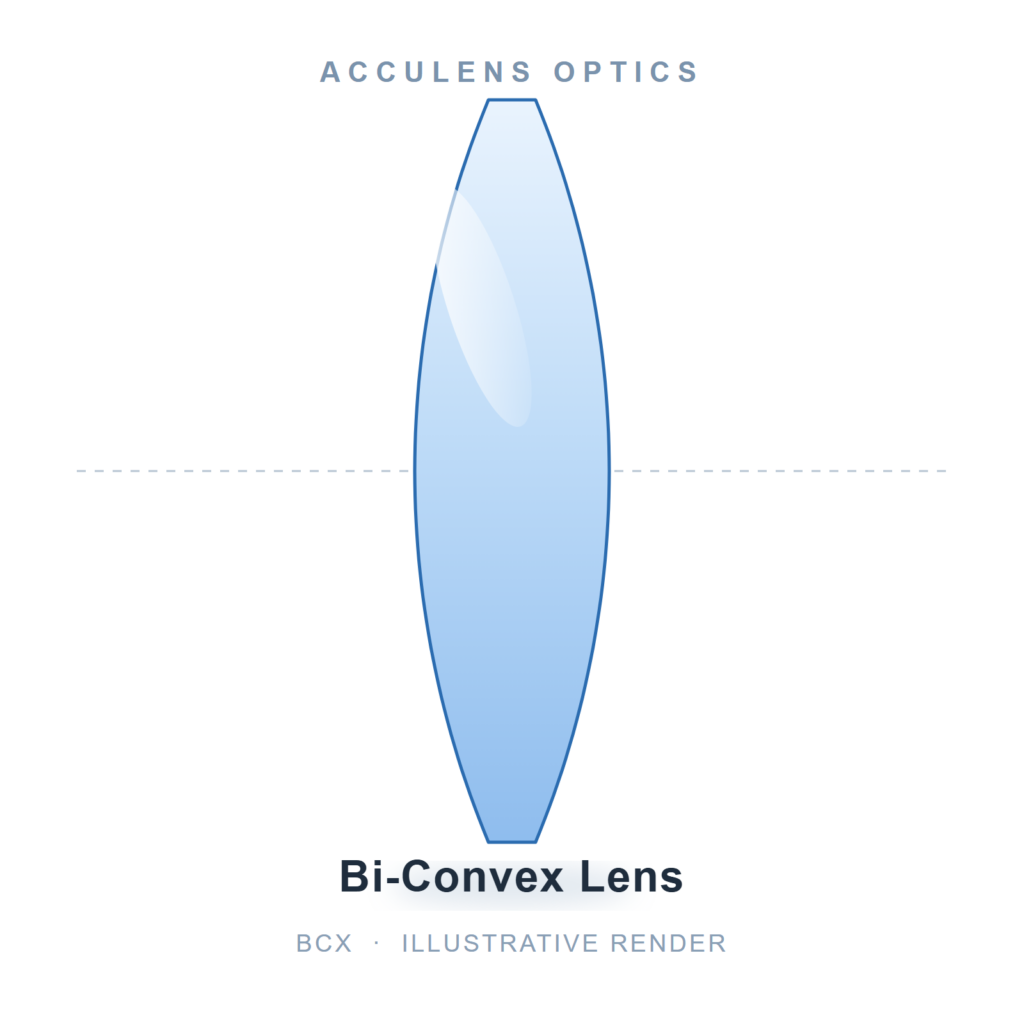
Bi-convex lenses use two symmetric convex surfaces and are the preferred positive singlet for finite conjugate ratios near 1:1 — object and image at similar distances. Typical uses include relay imaging, condenser trains and moderate-NA imaging at low cost.
Key Features
• Best positive singlet for 1:1 conjugates
• Symmetric geometry simplifies mounting
• Custom diameters, focal lengths, center/edge thickness
• Crown/flint glass families; band per material
Specifications
Diameter — per drawing / confirmed at quotation
Effective Focal Length — per drawing / confirmed at quotation
Center Thickness — per drawing / confirmed at quotation
Edge Thickness — per drawing / confirmed at quotation
Radius R1/R2 — per drawing / confirmed at quotation
Material — per drawing / confirmed at quotation
Surface Accuracy (N/ΔN) — per drawing / confirmed at quotation
Surface Quality (S/D) — per drawing / confirmed at quotation
Centration — per drawing / confirmed at quotation
Coating — per drawing / confirmed at quotation
Band — per drawing / confirmed at quotation
Customization
Send your PDF drawing with diameter, focal length, thickness, material, tolerance and coating requirements — our engineers review it and reply with DFM feedback within 48 working hours.